
May 21st, 2026
Ever thought about what happens when a building technically has water, but it struggles to reach it stably at different sections of it? Restrooms, cleaning operations, and automatic systems often fail to operate effectively in commercial buildings. It results in dissatisfaction and back-to-back complaints to faculty members and owners. Today, we will discuss the solution hundreds of engineers, property owners, and plumbers rely on. Stay with us to discover how water booster pumps in Pennsylvania resolve pressure inconsistencies.
In most tall commercial structures, the problem is not the availability of water; the water comes from sources. Water supply is certainly not the issue here; water distribution is the real deal breaker.
At ground level, both water distribution and supply work together unless the flow must reach multiple floors. It’s where the real challenge comes.
The building’s water distribution system weakens due to the gravity force at higher levels. Therefore, tenants living on the upper floors often face operational problems when plumbing lacks water booster pumps.
Hence, it is clear that in many commercial properties, the problem is not water availability. The real challenge lies in how efficiently water pressure is distributed throughout the building.
Engineers are turning to Pennsylvania water booster pumps to address unstable water flow. These systems are designed to stabilize the water pressure as it moves to a higher elevation. Engineers know that municipal pressure alone cannot meet the required pressure. However, installing just any pump does not provide a solution either. For the best and most effective outcomes, you need to find out, “What pump size do I need?
If a pump is selected at random, sizing issues can result in problems such as fluctuation, disturbing noises, rattling, premature wear and tear, excessive energy consumption, frequent pump cycling, and more.
On the other hand, a correctly sized and engineered Pennsylvania water booster pump gives a stable pressure distribution while maintaining long-term reliability.
A careful evaluation is often conducted when a professional considers choosing Pennsylvania water booster pumps. They analyze the building infrastructure and the demand for pressure and flow before selecting the appropriate pump configuration.
Water pressure naturally decreases with increasing building height. To make the water flow reach higher floors, engineers must determine the static head. It is the distance the water has to travel from the source to the destination.
By calculation, skilled engineers determine the required pressure so that water can reach the highest fixtures. The taller the building, the greater the pressure required to deliver consistent flow to the upper floors.
Commercial buildings rarely operate with a single fixture at a time; taps & dishwashers, irrigation systems, and maintenance operations run simultaneously. Plumbers choose the pump system that meets the peak water usage.
When water moves through pipes and valves, it loses certain pressure due to friction with the material. Large commercial properties with extensive water source networks often face this issue. A properly sized water booster pump compensates for this loss, so pressure remains stable throughout the system.
The last factor to consider when engineers select the perfect water booster pump size is the design technology used. Many new technologies have been integrated into the plumbing system to make it more energy efficient.
Instead of running continuously at full capacity, the system adjusts output based on the amount of water the building requires at any given moment. Hence, by choosing such pumps, energy consumption and mechanical stress are reduced.
Once you have evaluated the right size of a water booster pump, the next step is to consider a pump engineered for long-term performance.
We don’t want basic pump technology where needs are critical, essentially in commercial environments. Here, professionals inspect the pump design, internal components, pressure-control mechanisms, and performance.
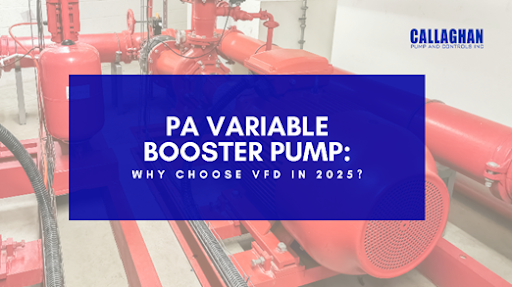
Modern Pennsylvania pumps are designed to meet advanced requirements and typically feature advanced controls, variable-speed drives, and intelligent pressure management to support complex building water networks.
For all good reasons, selecting a well-engineered Pennsylvania water booster pump becomes just as important as sizing it correctly. With this, you can have confidence in pressure delivery and energy usage. For the best investment, a seasoned booster pump dealer can help you cross the river. We suggest you look for experienced pump dealers in Pennsylvania or in your local area.
Callaghan Pump has been delivering robust, modern water booster pumps in PA. For better insights into the services, you can check the featured projects to analyze how the experts have enhanced water flow in different infrastructures with distinctive pump types. You can always contact the team directly and share your concerns.
john@callaghanpump.com,
eileen@callaghanpump.com,
dan@callaghanpump.com,
sales@callaghanpump.com,
service@callaghanpump.com